

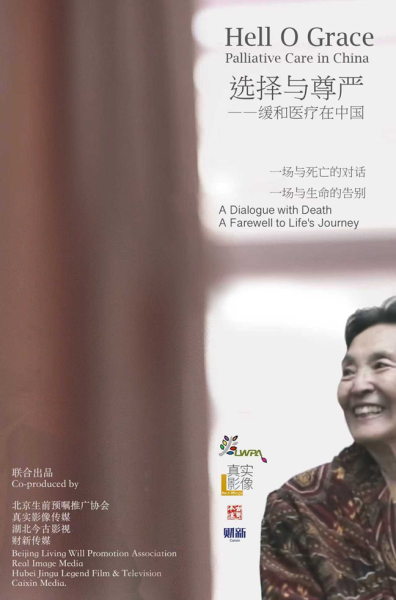
China, 31st Jul 2026 – A decade-spanning Chinese documentary examining palliative care and end-of-life decision-making has drawn widespread attention among overseas scholars and Asia-focused documentary practitioners. Titled Hell O Grace – Palliative Care in China, the feature is recognized as the first systematic visual documentation of the country’s evolving palliative care landscape. Co-produced by the Living Will Promotion Association and Real Image China, the film has secured multi-territory international releases, premiering exclusively across South Asia via regional media outlet The Asia Live and launching globally in multilingual formats, including Arabic, on the international platform That’s Books.
Departing from conventional state-centric narratives and geopolitical framing, the film gains global traction purely through its restrained, observational cinematic language. Its international reception has sparked sociological interest precisely because its core subject addresses shared social challenges prevalent across transitioning societies in Asia and the Middle East. Transcending diverse religious and cultural contexts, the documentary has inadvertently fostered cross-border academic dialogue and comparative research on end-of-life dignity.
Artistic Neutrality: Western Documentary Syntax with Eastern Emotional Restraint
Media observers and film critics attribute the work’s successful cross-cultural penetration to its deliberate deconstruction of stereotyped visual and narrative symbolism. The production adopts the observational principles of classic Direct Cinema, defined by non-intrusive filming and unbiased scene documentation. It rejects didactic moralising and institutional glorification, positioning the camera as a neutral recorder of everyday reality.
Beneath its detached, journalistic objectivity lies a distinctly Eastern tonal quality—understated, introspective, and emotionally restrained—granting the film a universal rationality that transcends cultural boundaries. In an in-depth academic analysis, a Harvard scholar Mr. Jian Yi commented:
“More than a record of medical progress, Palliative Care in China functions as a universal mirror reflecting humanity’s shared limitations within modern medical systems. Through sophisticated visual storytelling, it transforms heavy ethical dilemmas into profound philosophical inquiries about what constitutes a dignified human life.”
Social Mirror: Modernity Pressures in Transitional Asian and Middle Eastern Societies
Beyond its artistic merits, sociological analysts argue the documentary’s dual resonance across South Asian and Arabic-speaking regions stems from its incisive capture of common societal growing pains. Rapid urbanisation, accelerated modern lifestyles, and shifting demographic structures are dismantling long-standing multigenerational family frameworks and traditional community-based elderly and end-of-life care systems across both South Asia and the Middle East.
Emerging at this pivotal moment of social transformation, China’s decade-long palliative care case study has prompted independent regional scholars to conduct layered comparative sociological reflections:
•In rapidly urbanising South Asian societies, how can communities rebuild dignified, cost-effective end-of-life support systems amid ruptures between modern medical resources and traditional communal care bonds?
•In Arabic-speaking regions, where advanced medical technology enables indefinite life prolongation, how can individual autonomy and quality of life be redefined and protected?
By illuminating these intertwined social, economic, and public health transitions, the film delivers substantial sociological research value, far exceeding the cultural influence of ordinary documentary productions.
Interfaith Reflection: Ethical Dialogue Across Diverse Cultural Contexts
For global distribution professionals and cross-cultural anthropologists, the documentary’s international release offers valuable industry insight: realistic social issue filmmaking can facilitate constructive cross-cultural dialogue on end-of-life ethics across divergent religious and societal landscapes.
South Asia’s complex spiritual traditions—encompassing Hinduism, Buddhism, and Islam—and the dominant Islamic cultural framework across the Middle East hold distinct theological and ethical interpretations of suffering, fate, physical existence, and mortality.
Despite these profound doctrinal differences, scholars have observed universal emotional and existential commonalities in how individuals confront terminal illness, loss, and parting across regions. Rooted in restrained, human-centered storytelling, the film encourages cross-disciplinary researchers to revisit local end-of-life medical ethics and care paradigms through a comparative, global lens.
Media Contact
Organization: Global Services
Contact Person: Jesse
Website: https://www.caixin.com/
Email: Send Email
Country:China
Release id:46110
The post First Documentary on China’s Palliative Care: Societal Change and End-of-Life Ethics appeared first on King Newswire. This content is provided by a third-party source.. King Newswire makes no warranties or representations in connection with it. King Newswire is a press release distribution agency and does not endorse or verify the claims made in this release. If you have any complaints or copyright concerns related to this article, please contact the company listed in the ‘Media Contact’ section
Disclaimer: The views, suggestions, and opinions expressed here are the sole responsibility of the experts. No Knox Market Research journalist was involved in the writing and production of this article.
